Saturday, May 26, 2012

Fimbriate desert-parsley (Lomatium foeniculaceum var. fimbriatum) near Alturas, Modoc County?


In California, Lomatium foeniculaceum is represented by 3 of the five races treated by Theobold (Brittonia 18:1-18. 1966) and Holmgren (Intermountain Flora Vol. 3A. 1997).  Records attribute all of the Modoc Plateau occurrences as Lomatium foeniculaceum var. macdougalii, CNPS List 2.2, a rare plant.

Holmgren and TJM2 keys respectively distinguish var. fimbriatum on the basis of “petals ciliolate margined (unique in the species)” and “petal margin minutely ciliate”.


Plants of the population of Lomatium foeniculaceum on the southerly outskirts of Alturas were in flower this year on May 16th.  Plants in this occurrence have petals that are NOT glabrous on the surface nor on the petal margin, making them similar to the circumscription of var. fimbriatum.  The EO#10 plants do not have the very regular, minutely ciliate petal margins with glabrous petal faces illustrated in Intermountain Flora Vol. 3A p. 407.  Rather, they are have irregular, dense trichomes over both the petal surface and irregularly along the petal margin.

Many of the Modoc County locations of Lomatium foeniculaceum lack a voucher specimen, making determination of the petal glabrous/pubescent feature uncertain.   Lomatium foeniculaceum var. fimbriatum was described from a White Mountain, Inyo County type attributed to deposition at LA.  The holotype was not cited as seen by Holmgren (Intermountain Flora Vol. 3A. 1997) nor are any isotypes in any of the major herbaria databases (NY, MO, US, UC).   In the CNPS Inventory the statement is made "Lassen County plants may be undescribed".  Indeed, perhaps there is a 6th infrataxon of Lomatium foeniculaceum, one in which the petals are pubescent but regularly fimbriate as in var. fimbriatum.

The relatively poor photo shows a magnified image of the flowers and their abundant petal trichomes (red arrows show examples)

Wednesday, May 23, 2012

The long lost Mimulus whippleyi may not be all that lost


Mimulus whippleyi A.L. Grant (1924) is a California endemic that has been considered potentially extinct since the inception of the rare plant program.  Now (Phytoneuron 2012-40: p. 44) we find that M. whippleyi is supplanted by an earlier name, M. marmoratus Greene (Erythea 3:73. 1895).  More importantly, Nesom’s treatment adds considerably  to the number of known specimens (well, two more).

Erythranthe marmorata (Greene) Nesom is now the correct name.

Stations:
1. California, Stanislaus County, Knight’s Ferry, moist rocks, 9 Apr 1895, F.W. Bancroft s.n. (lectotype ND-Greene 046328; isolectotypes: ND-Greene 046329, UC27030) – approx 37.82044/-120.65836 200 feet

2.  California, Calaveras County, Murphy’s [Camp], rocky hillsides, J.14 May 1854, J.M. Bigelow s.n.
(holotype: GH , isotype US42132) – approx. 38.12494/-120.41578 2600 feet

3.  California, Amador[?] County, George Hansen, 13 May 1896, 1200 ft (NDG46544) or April 1892 (UC103735), 1800 ft; or April 1892, 2000 ft (UC193097) – vicinity 38.37/-120.61

I have been unable as yet find the exact location of Hansen’s placenames “Fisher’s Cabin” or “Fisher’s Point” – the name does not appear on the 1897 edition of the Jackson or Big Trees USGS 30’ quadrangle, nor in the USGS Gazetteer, nor in the Jepson Herbarium placenames database, nor in Durham’s Place Names of California.  Neither of the Hansen place names appear in the 1881 “History of Amador County”.  Based on the format of Hansen’s specimen labels, which generally form an elevation progression.  The station is threfore arbitrarily mapped at the confluence of the Mokelumne River and Middle Fork Mokelumne River.

The ND-G specimen of Hansen 473 is cited as Erythranthe marmorata (Greene) Nesom, Phytoneuron 2012-40: 44. 2012[=Mimulus whippleyi A.L. Grant, CNPS List 1A – presumed extinct].  The digital image of ND-G 46544 gives the location as “Fisher’s Cabin....1200 ft”

The image shows the general format of one version of Hansen’s specimen label

Sunday, April 1, 2012

Badly Needed: Horticultural Invasiveness Risk Assessment Ranking System for California


The revised Jepson Manual gives me the view that we have a even stronger picture of the endemic and native flora of California than the first 1993 edition.  By contrast, the new Manual shows me that we have a primitive or no clue as to where the invasive flora is trending. 

Based on an ongoing comparison of Calflora, taxa in TJM2 and JPF categories for waifs, garden weeds etc, and CCH specimen records, I find there is about a 1/3 correspondence.  TJM2 treats about 1207 ‘established’ exotics ; 296 ‘waifs; 130 ‘garden weeds’; 72 ‘cultivated’ –1705 taxa total.  By contrast, CALFLORA has about 800 more names for non-natives!    Circa. 300 species are in CCH that rare not in Index to California Plant Names Current Status Categories.  Preliminary perusal of the CCH and the CALFLORA rosters clearly indicate to me that a sizeable number of cultivated, ornamentals have records in one or the other database. 

Which cultivated plants are risks?  Essentially, horticulture in California, with emphasis rightly on drought-tolerance, provides an ongoing infection pressure.  More and more new plants are offered each season, more and more some minor proportion of these might be the next Genista.  How to moderate this threat?

One thing that merits consideration is what, in Hawaii, is a Invasive Assessment Protocol, along the lines of Hawaii Exotic Plant Evaluation Protocol (Daehler et al 2004).  Color code the system; require labels in garden centers to bear symbols for invasive potential.

Given the native flora of California is 6600 or so taxa, given the non-native flora, some 2000± more taxa, and given that there are probably an ±3000-4000 (or larger?) number of cultivated, Mediterranean or temperate-origin plants in the trade in CA, the risk of not progressing in this arena is significant.


Daehler, C. C., J. S. Denslow, S. Ansari, and H. Kuo. 2004. A risk assessment system for screening out
 invasive pest plants from Hawai'i and other Pacific Islands. Conservation Biology 18:360-368.

Wednesday, March 28, 2012

California Botanists are doing a better job vouchering weeds


Based on analysis of 141,500 CCH specimens of non-native plants from California, it is patently evident that we are doing a better job of vouchering weeds.  Herbarium specimens are time-consuming to collect, even more time consuming to key, label and mount, yet the graph above shows that the recent trend is upward (and, discount the actual accession rate for 2005 and beyond because of backlog of unprocessed material).  Remaining humble, we must remember that our now departed mentors of the 1930s, and departed or soon to be departed friends of the 1960s did their job well.

Saturday, March 24, 2012

History of introduction of Invasive/Adventive plants in California


As a field botanists in California, I fully admit being uninterested in “weeds” early on.  So many cool. endemic plants to seek out.  Once enough experience is gained, this viewpoint fortunately changed, as it ought to, into a caution.  Invasive plant biology has become a looming problem for many regions: as a Mediterranean climate region, California is predisposed to the acquisition of adventives from other regions. 

Working recently to examine the history of non-native plant introductions into California, I downloaded >140,000 CCH database records and have begun to examine the data for pattern.  The graph above is the pattern of acquisitions: based on the first specimen record for 1506 taxa. 

The most and perhaps most important first observation I offer is this: the pace of introduction is, for all purposes, linear over time.  Contrary to the important 1993 review (post Jepson Manual Ed. 1) review of Rejmanek  (Madrono 41:161-177. 1994) the pace seems not to be neither logistic, nor slowing down.  Hope for a solution would offer that some point we would reach a saturation in exotic species richness: the bad problem is no longer getting worse.  The graph above suggests that point is not yet in view.   Trends such as this require more research least we find, that at some point, homogenization of our flora becomes too massive a problem to avoid.  If landscape-scale species richness is a zero-sum game, then we have little time to ramp up our surveillance, study and control of invasives in CA.  We best hurry up from the shape of this graph.  The overall pace 1880-2010 is about 10 plants per yr (10.3 exactly).  

Saturday, March 3, 2012

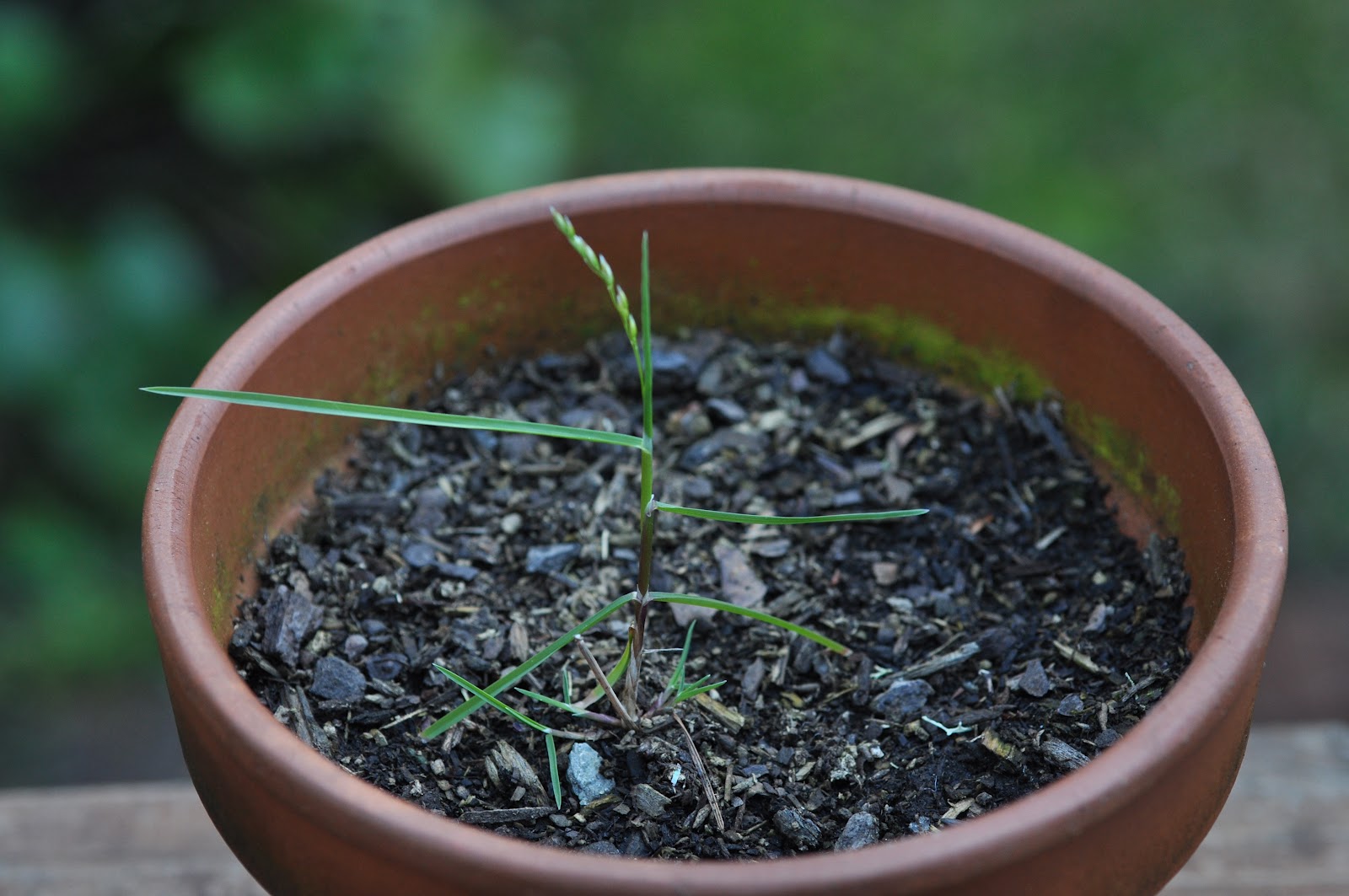
Precocious flowering of ramets in Poa sierrae


Photos: top to bottom – two ramets before potting, after 130 days, respectively. Note that the ramet with a single axis is smaller than the ramet that started with three axes!!!

Poa Section Madropoa is mostly restricted to high mountains of western North America.  Poa sierrae is odd within the clade: it is characterized as being rhizomatous, dioecious and by the distinctive scaly ‘bulbils’ produced on the rhizomes.  These ramets doubtless propagate by fragmentation, so it is puzzling why P. sierrae is quite narrowly distributed.

On August 3, 2011, Poa sierrae was collected (my #21,134) at the type locality (‘Lewisia’ rock near Belden, Feather River Canyon, Plumas County, CA).  Genets were potted up quickly thereafter, and kept moist throughout the fall.  These ramets remained dormant until mid-November, when, perhaps induced by decreasing daylength, they began growth.  Growth continued modestly once the ramets responded.  After about 130 days of growth, inflorescences began to emerge. 

Precocious flowering has been reported in Poaceae: tissue-cultured bamboo can be induced to flower  (Nature Nature 344, 335 - 336, 22 March 1990).  In Arabidopsis, precocious flowering is controlled by a pair of antagonistic genes (Science Vol. 286:1960-1962. 1999).

Ordinarily, sensu Baker & Stebbins 'Genetics of Colonizing Species' one would conclude that a vegetatively spreading, precociously flowering species would be weedy.  For Poa sierra, exactly not.


Friday, December 9, 2011

spelling of Ribes nevadense


Its plain that Albert Kellogg was, reasonably,  avuncular, yet peculiar, in his choice of plant names.  Take Marah – the etymology of which drove Kate Brandegee nuts.

Rines Navadaensis was founded on the lower left-column of page 63 the Proceedings California Academy of Natural Sciences on July 16, 1855 in San Francisco.  Dr. Lanswweert was in the Chair, and the meeting recorded “Donations to the Cabinet”.  Perhaps if all copies of the Academy proceedings had perished along with the herbarium in the 1906 earthquake and fire, we would not be left with a problem. The problem is Ribes nevadense Kellogg.  That is, how to spell the epithet of this common Sierra Nevada gooseberry. 

First, we credit Dr. Lanswweert because, from his Chair in the chair, he noted the “wild Black Mountain currant” the fruit ‘by a little culture would undoubtedly improve in every respect.”  On the upper right hand column of page 64 “The Academy and the public are indebted to the generosity of the Pacific Express Company for these value able acquisitions.

That is, the currant came to Kellogg in San Francisco via “pony express”.  The era was, as I make it out it, one of start ups:  Adams & Company was an express begun in 1849, and following that company's failure in Feb, 1855, cowboys out of a job formed the Pacific Express Company “under the leadership of Russell G. Noyes.” Instead of supplementing Wells Fargo, they offered competition.  [see: westerncoversociety.com]

Thusly, the type of Ribes nevadense Kellogg, which is imaged at CAS, does not look all too fresh. That’s fine considering having bounced down in saddlebags to Sacramento, then onto a paddle wheeled steamer to The City.

The crux of the problem is this: the printed ‘protologue’ attached to the holotype, which is not the actual protologue, spells the name Ribes nevadense Kellogg – current and historic usage. 

O.k. is it Ribes nevadensis Kellogg, Ribes nevadaense Kellogg (as in Tropicos), or Ribes nevadense? Navadaensis seems to be just a typographical error: lead type set by hand ought to have such errors very frequently. In fact. the typographer coined a new genus “Rines” at the same instant (perhaps "b" was in short supply). Given what is at hand, Kellogg’s name was intended to denote “of the Sierra Nevada” –nevadensis, and not “of Nevada” – nevadaensis.  Thus, Ribes nevadensis Kellogg ought to spelled as such.  This spelling saga is now recorded.