Wednesday, March 28, 2012

California Botanists are doing a better job vouchering weeds


Based on analysis of 141,500 CCH specimens of non-native plants from California, it is patently evident that we are doing a better job of vouchering weeds.  Herbarium specimens are time-consuming to collect, even more time consuming to key, label and mount, yet the graph above shows that the recent trend is upward (and, discount the actual accession rate for 2005 and beyond because of backlog of unprocessed material).  Remaining humble, we must remember that our now departed mentors of the 1930s, and departed or soon to be departed friends of the 1960s did their job well.

Saturday, March 24, 2012

History of introduction of Invasive/Adventive plants in California


As a field botanists in California, I fully admit being uninterested in “weeds” early on.  So many cool. endemic plants to seek out.  Once enough experience is gained, this viewpoint fortunately changed, as it ought to, into a caution.  Invasive plant biology has become a looming problem for many regions: as a Mediterranean climate region, California is predisposed to the acquisition of adventives from other regions. 

Working recently to examine the history of non-native plant introductions into California, I downloaded >140,000 CCH database records and have begun to examine the data for pattern.  The graph above is the pattern of acquisitions: based on the first specimen record for 1506 taxa. 

The most and perhaps most important first observation I offer is this: the pace of introduction is, for all purposes, linear over time.  Contrary to the important 1993 review (post Jepson Manual Ed. 1) review of Rejmanek  (Madrono 41:161-177. 1994) the pace seems not to be neither logistic, nor slowing down.  Hope for a solution would offer that some point we would reach a saturation in exotic species richness: the bad problem is no longer getting worse.  The graph above suggests that point is not yet in view.   Trends such as this require more research least we find, that at some point, homogenization of our flora becomes too massive a problem to avoid.  If landscape-scale species richness is a zero-sum game, then we have little time to ramp up our surveillance, study and control of invasives in CA.  We best hurry up from the shape of this graph.  The overall pace 1880-2010 is about 10 plants per yr (10.3 exactly).  

Saturday, March 3, 2012

Precocious flowering of ramets in Poa sierrae


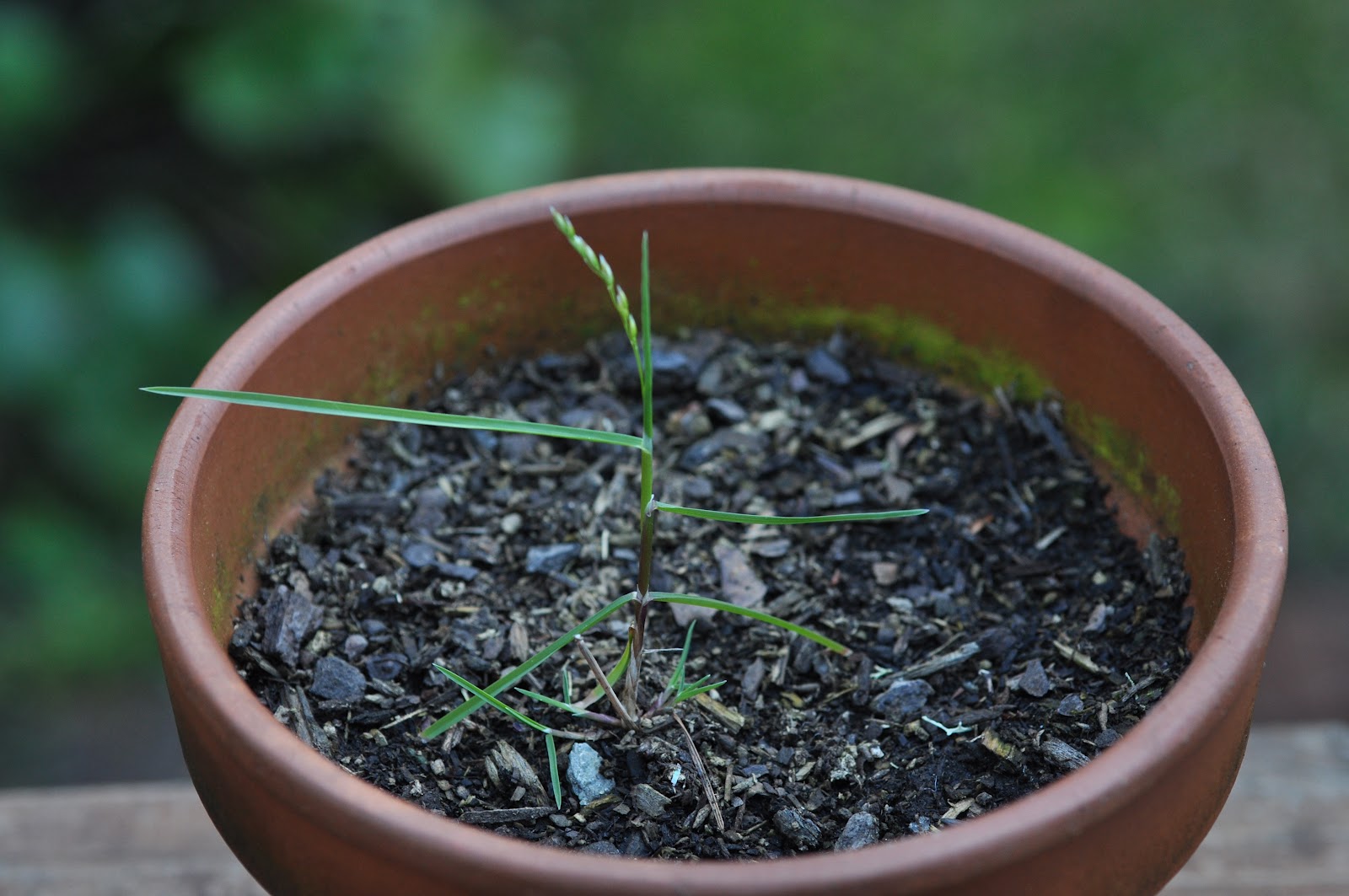
Photos: top to bottom – two ramets before potting, after 130 days, respectively. Note that the ramet with a single axis is smaller than the ramet that started with three axes!!!

Poa Section Madropoa is mostly restricted to high mountains of western North America.  Poa sierrae is odd within the clade: it is characterized as being rhizomatous, dioecious and by the distinctive scaly ‘bulbils’ produced on the rhizomes.  These ramets doubtless propagate by fragmentation, so it is puzzling why P. sierrae is quite narrowly distributed.

On August 3, 2011, Poa sierrae was collected (my #21,134) at the type locality (‘Lewisia’ rock near Belden, Feather River Canyon, Plumas County, CA).  Genets were potted up quickly thereafter, and kept moist throughout the fall.  These ramets remained dormant until mid-November, when, perhaps induced by decreasing daylength, they began growth.  Growth continued modestly once the ramets responded.  After about 130 days of growth, inflorescences began to emerge. 

Precocious flowering has been reported in Poaceae: tissue-cultured bamboo can be induced to flower  (Nature Nature 344, 335 - 336, 22 March 1990).  In Arabidopsis, precocious flowering is controlled by a pair of antagonistic genes (Science Vol. 286:1960-1962. 1999).

Ordinarily, sensu Baker & Stebbins 'Genetics of Colonizing Species' one would conclude that a vegetatively spreading, precociously flowering species would be weedy.  For Poa sierra, exactly not.


Friday, December 9, 2011

spelling of Ribes nevadense


Its plain that Albert Kellogg was, reasonably,  avuncular, yet peculiar, in his choice of plant names.  Take Marah – the etymology of which drove Kate Brandegee nuts.

Rines Navadaensis was founded on the lower left-column of page 63 the Proceedings California Academy of Natural Sciences on July 16, 1855 in San Francisco.  Dr. Lanswweert was in the Chair, and the meeting recorded “Donations to the Cabinet”.  Perhaps if all copies of the Academy proceedings had perished along with the herbarium in the 1906 earthquake and fire, we would not be left with a problem. The problem is Ribes nevadense Kellogg.  That is, how to spell the epithet of this common Sierra Nevada gooseberry. 

First, we credit Dr. Lanswweert because, from his Chair in the chair, he noted the “wild Black Mountain currant” the fruit ‘by a little culture would undoubtedly improve in every respect.”  On the upper right hand column of page 64 “The Academy and the public are indebted to the generosity of the Pacific Express Company for these value able acquisitions.

That is, the currant came to Kellogg in San Francisco via “pony express”.  The era was, as I make it out it, one of start ups:  Adams & Company was an express begun in 1849, and following that company's failure in Feb, 1855, cowboys out of a job formed the Pacific Express Company “under the leadership of Russell G. Noyes.” Instead of supplementing Wells Fargo, they offered competition.  [see: westerncoversociety.com]

Thusly, the type of Ribes nevadense Kellogg, which is imaged at CAS, does not look all too fresh. That’s fine considering having bounced down in saddlebags to Sacramento, then onto a paddle wheeled steamer to The City.

The crux of the problem is this: the printed ‘protologue’ attached to the holotype, which is not the actual protologue, spells the name Ribes nevadense Kellogg – current and historic usage. 

O.k. is it Ribes nevadensis Kellogg, Ribes nevadaense Kellogg (as in Tropicos), or Ribes nevadense? Navadaensis seems to be just a typographical error: lead type set by hand ought to have such errors very frequently. In fact. the typographer coined a new genus “Rines” at the same instant (perhaps "b" was in short supply). Given what is at hand, Kellogg’s name was intended to denote “of the Sierra Nevada” –nevadensis, and not “of Nevada” – nevadaensis.  Thus, Ribes nevadensis Kellogg ought to spelled as such.  This spelling saga is now recorded.


Tuesday, November 22, 2011

albino phenotype in Sequoia sempervirens


albinistic mutations are often recorded in Redwood (Sequoia sempervirens).  Popular literature indicates these mutations are 'very rare' in S. sempervirens: Discover Magazine has “25 of these trees are known to exist around the world, eight of which are at Henry Cowell State Park in California”, while “Field Notes by Barry Evans”, The Journal, Humboldt County “Only about 50 are known to exist”.  Exactly how frequent these mutations occur is uncertain.  

Insofar as I find in literature, there is no certainty as to the type of mutation that results in albinsitic crown sprouts in S. sempervirens.  In general, the albino phenotype in vascular plants results from mutations in either nuclear genes that code precursors for plastid biogenesis, or in chloroplast genes, and at least in grasses, plants with nuclear mutations often have plastids with only carotenoid pigments present, producing a faint yellow in the affected leaves.   The color of the mutant S. sempervirens below suggests no mature carotenoid pigments form, as there is no hint of yellow pigment.

This albino S. sempervirens occurs near Nisene Marks State Park, Santa Cruz, County.  This particular clump has been essentially this size, about 2 meters tall, for nearly 2 decades now, although individual stem axes die and are replaced.    The principal factor seemingly associated with the state of this particular clump is that it gets ‘smothered’ by litterfall, which has broken or bent down individual stem axes over the years. 

The albino phenotype of S. sempervirens was reported upon by George J. Peirce in Proceedings California Academy of Sciences, Third Series, Botany, Volume 2, p. 83-107 (1900-1904), and reading his article it seems these albino trees were known from throughout the Bay Area early on.  Peirce termed them  “not an especially rare peculiarity” and “I have entirely failed to detect even rudiments of plastids” on plants from near La Honda, while albino mutants from near Redwood Retreat (vicinity of Gilroy) he states “contained chromatophores which ranged in size from those about half as large as the average chloroplastids in the normal green leaves down to indistinguishable rudiments.”  His observations might therefore suggest that these albino forms can result from a mutations either in nuclear or chloroplast genes.  

Friday, November 18, 2011

Ramet ‘germination’ in Poa sierrae


My dormant ramets of Poa sierrae, collected at the type station on 1 August 2011, were potted up soon thereafter and were kept well watered throughout the late summer.  Not until daylength began to shorten about Halloween, and the wet season returned, did they begin new growth, however.  In this view, the ramet piece shown in the middle photo of the 18 September 2011 post on Poa sierrae has grown out, and a secondary ramet has formed.  Ramet reproduction thus seems to be a strong tendency under gene (vs. allelic) control in this member of Madropoa.    In some respects, the strength of ramet reproduction contradicts the narrow geographic range of this Sierra Nevada dioecious endemic: it seems odd, because on the surface the ease of vegetative  reproduction would otherwise be characteristic of a vagile or even invasive species of grass.  Go figure.

Saturday, November 12, 2011

Hooveria, a new genus liberated from Chlorogalum


Chlorogalum as treated traditionally is a genus of 8 taxa endemic to the California Floristic province, extending in the north from its northern limit near Myrtle Creek, Josephine County, Oregon southward to far northern Baja California.   Four of the 8 taxa are rare
              
The genus clearly consists of two distinct elements: three pale to deep purple flowered, diurnal taxa
n = 30    Chlorogalum purpureum Brandegee var. purpureum
n = ???   Chlorogalum purpureum var. reductum Hoover
n = 30    Chlorogalum parviflorum S. Watson
and 5 white flowered, verpertine taxa
n = 17       Chlorogalum angustifolium Kellogg
n = ??       Chlorogalum grandiflorum Hoover
n = 18      Chlorogalum pomeridianum (DC) Kunth var. divaricatum (Lindley) Hoover
n = 18      Chlorogalum pomeridianum var. minus Hoover
n = 15, 17 Chlorogalum pomeridianum var. pomeridianum

In 1940, Hoover (1) did not know of the tetrapolid nature of the two n=30 species, C. parvifolium and C. purpureum; he did remark on the floral differences.  Cave (2) then documented chromosome numbers in the genus, postulating they represented a distinct clade and noted their karyotpyic links with Hastingsia alba.   Now, Halpin (3) has shown that the diurnal-flowered plants are not monophylletic within Chlorogalum.  

In my estimation, Chlorogalum purpureum and C. parviflorum ought to be segregated within a new genus.  The name Hooveria is available for these plants, and would be a fitting tribute for Robert Francis Hoover, one of California’s most able field botanists.

1.  Hoover, RF 1940  Madrono 5:137-147
2.  Cave, MS 1970 Univ. Calif. Pubs. Bot. 57:1-51
3.  Halpin, KM. 2011.  Thesis, Oklahoma State Univ. 103 pp.